Wood Floor Staining
Impressive Floor Staining Service - Free Staining Samples
Changing the colour of your wooden floor is one of the most effective ways to completely transform your home. Whether you want to turn aged pine into a rich antique oak, create an airy modern whitewash, or keep your timber looking completely raw and natural, professional wood floor staining gives you endless design options.
At floorsanding.london, our wood floor restoration services combine deep technical knowledge with industry-leading products from Morrells, Bona, and Loba.
Here is everything you need to know about how the staining process works, how to prepare your home, and what colour combinations are possible.
Getting Your Space Ready: What You Need to Know
To ensure a smooth, even, and consistent stain across your entire room, careful preparation is required before our machines arrive.
Rooms Should Be Completely Clear of Furniture
For the stain to take evenly across your floor, the entire area should be completely empty of all furniture, rugs, and curtains.
-
Why this matters
Staining cannot be done in halves. If furniture is left in the room or shuffled from one side to the other during the process, it creates visible overlap marks, stop-lines, and noticeable colour differences. The stain and protective topcoats will simply not match.
-
Our Furniture Moving Service
We kindly ask customers to clear their rooms before our arrival. However, if you have heavy or bulky items you cannot move yourself, we offer a professional furniture-moving service for an additional charge. Just let us know during your initial survey so we can factor this into your schedule.
Timeframes & Investment: Our Premium 2-in-1 Oil & Lacquer System
While standard clear lacquering typically takes around 2 days, choosing a complex colour transformation using a combined oil-and-lacquer system takes 3 full days.
-
The Drying Window
When applying a rich penetrating base like Bona Craft Oil 2K, the oil must penetrate the timber pores and dry thoroughly overnight.
-
Next-Day Lacquer Sealing
The following day, our team returns to lock in the colour and seal the surface with durable commercial-grade lacquer (such as Bona Traffic HD or Loba 2K InvisibleProtect).
-
Cost Factor
Because this multi-stage system requires specialised product chemistry, intensive mechanical buffing, and an extra full working day on site, it carries a slightly higher price than standard clear varnish. The result, however, is a durable, scratch-resistant surface with deep, rich colour.
Modern Natural Looks
Years ago, older solvent-based varnishes had a noticeable drawback: they quickly turned clear wood into an unnatural, honey-yellow or amber colour over time.
Today, modern lacquer technology has evolved. You don’t need a wood stain to achieve a pale, raw, or contemporary light aesthetic. However, If you still would like to stain your wooden floors there are several key factors to consider to ensure you achieve the exact tone, depth, and finish you want.
Staining is a fantastic way to personalize your interior, whether your goal is to add architectural drama with deep, moody charcoals, introduce warm antique walnut tones, or neutralize stubborn yellow and orange undertones in aged pine.
There are also high-performance primers and specialised topcoats can preserve the natural, untreated look of freshly cut timber without yellowing:
-
The "Invisible / Untreated" Look
Products like Loba 2K InvisibleProtect or Bona Traffic Raw seal and protect the timber against heavy foot traffic while remaining completely invisible to the eye. Your floor retains the natural, matte texture and pale tone of bare wood.
-
The Modern Whitewash Effect
Using tinted primers like Bona White or Loba EasyWhite, we can lighten the floor's base tone without using a heavy coloured stain. A single coat gently cancels out yellow tones, while two to three coats build a smooth, milky wash.
Premium Brands & Popular Colour Choices
Every floor responds to colour differently based on its age, species, and grain density. We select our staining systems from three industry-leading manufacturers:
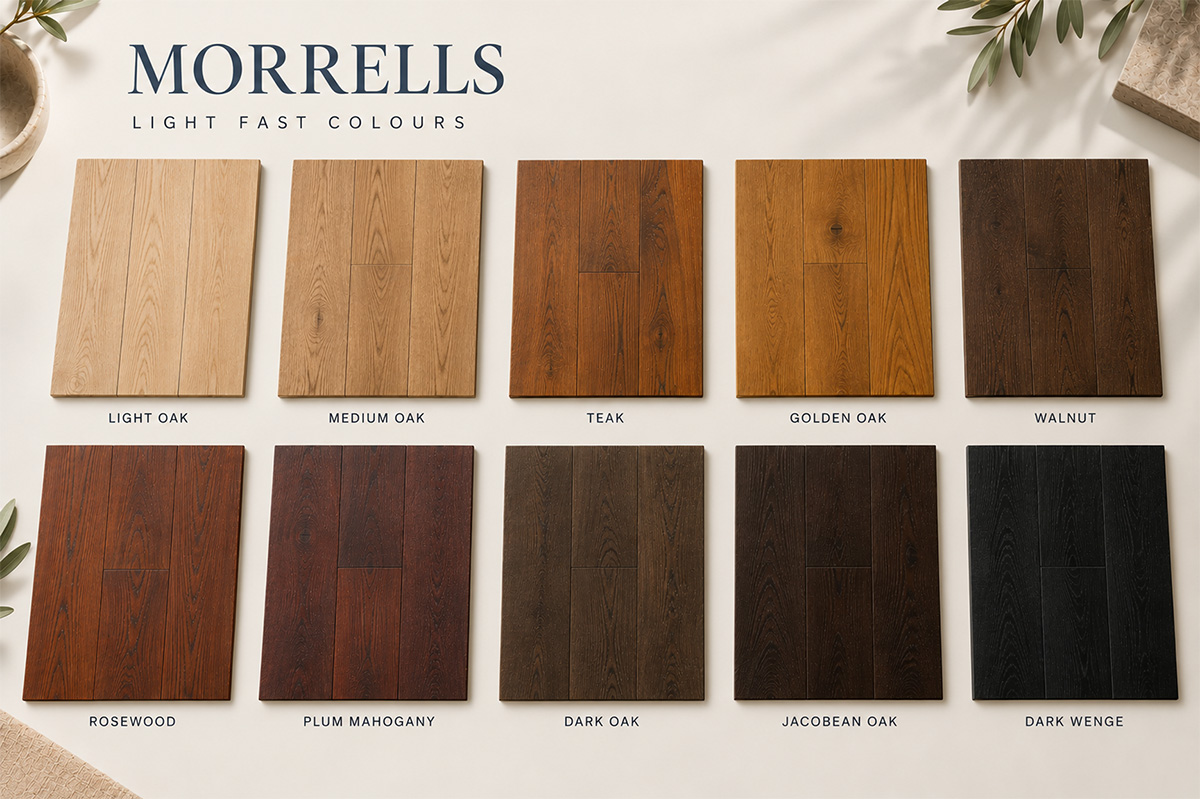
Morrells Light Fast (LF) Stains
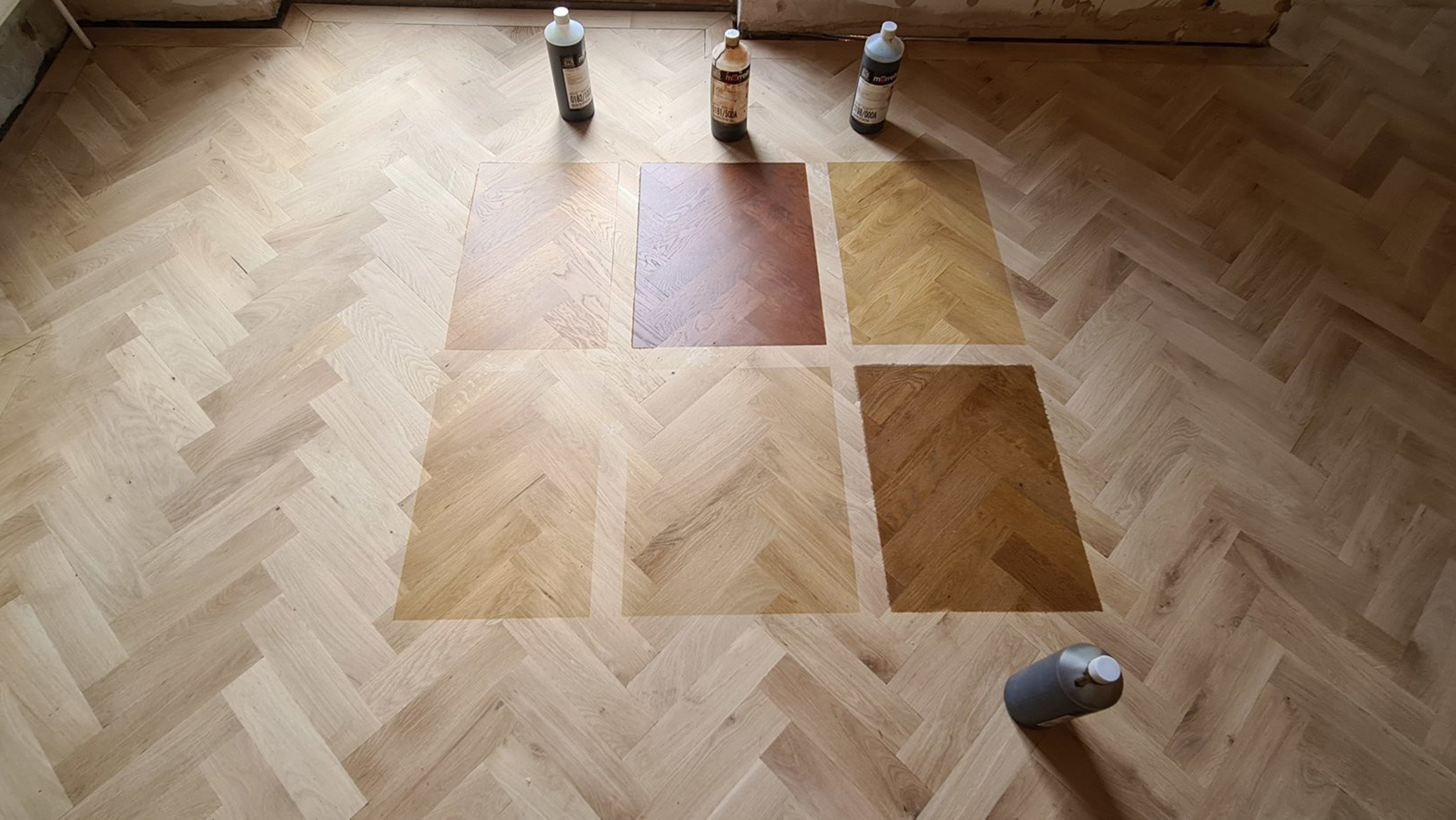
Morrells spirit-based stains are renowned for fast drying and deep, consistent colour penetration. They are particularly effective on pine floorboards and oak when you want to achieve classic, darker tones under clear lacquer:
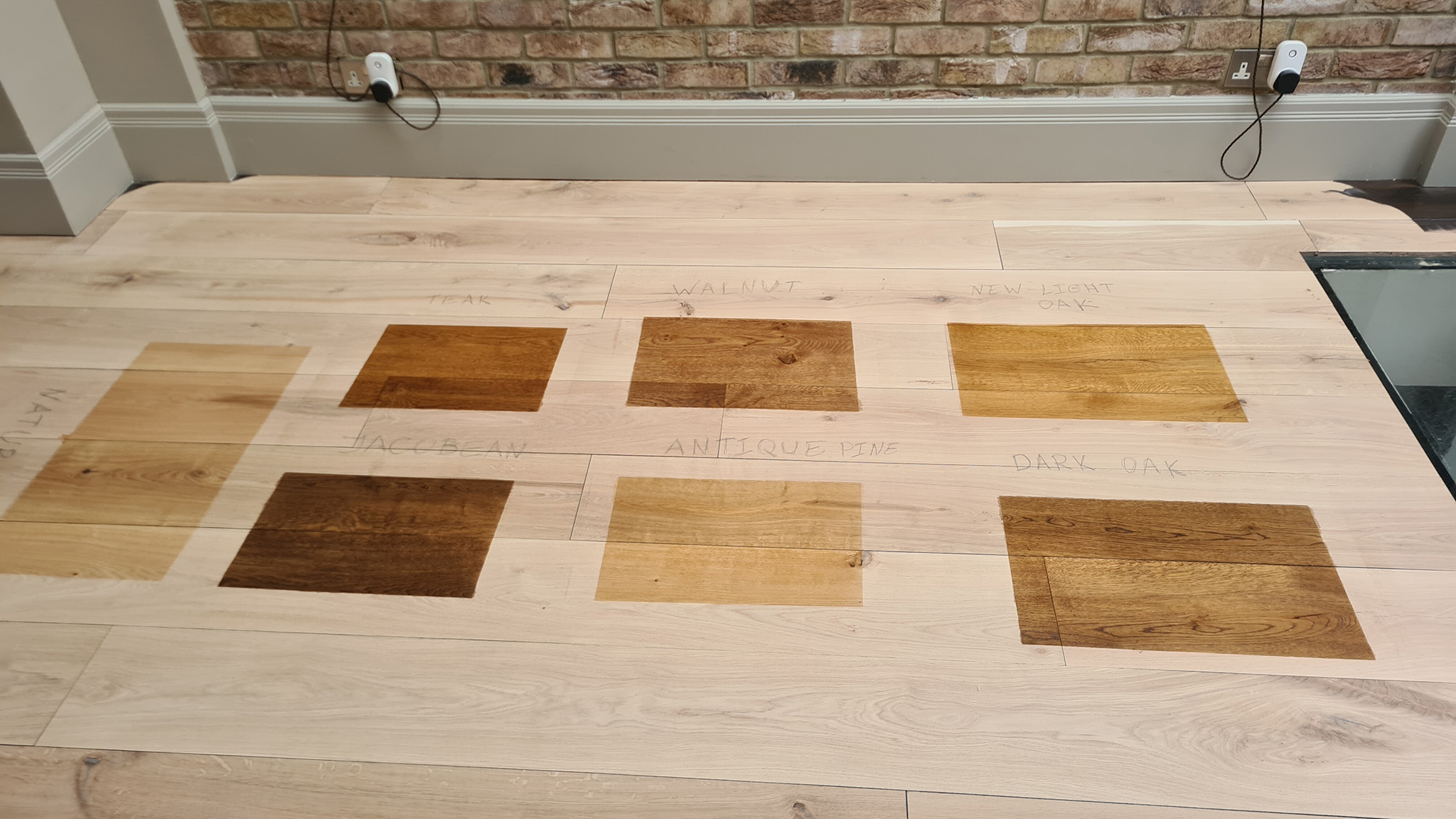
Jacobean Oak & Dark Oak: Deep, rich browns that add warmth to Victorian and Edwardian properties.
Antique Pine & Victorian Pine: Mutes unnatural yellow tones and enriches original pine boards with a warm, aged amber tone.
Walnut & Medium Oak: Classic mid-brown shades that mimic luxury hardwoods.
Teak, Mahogany & Rosewood: Red-brown heritage tones ideal for period properties.
Bona Craft Oil 2K & Bona Create
Bona's specialised colouring systems blend deep-penetrating oil pigments with the option of commercial lacquer topcoats:
Frost, Ash & Mist: Soft, contemporary greys and off-whites that brighten compact rooms.
Pure White & Nordic White: Clean, crisp whitewashes that highlight oak grain.
Clay, Sand & Graphite: Earthy, modern tones that pair well with minimalist interior design.
Loba ProColor & Pre-Treatments
Loba offers versatile liquid pigments and reactive primers designed for seamless application:
Balian Black & Smoked Oak: Dramatic, high-contrast charcoals and ebonies.
White & Grey Pastels: Subtle washes that accentuate ring-porous hardwoods without looking artificial.
Loba Active Colors: Specialised reactive treatments that interact directly with the natural tannins in oak, creating an authentic "fumed" or weathered look from within the wood fibers.
Wood Anatomy, Mechanics, and Sanding Calibration
Staining cannot be treated as a simple cosmetic wipe-on application. Stains—whether solvent-borne, water-based, or oil-dispersed—settle unevenly into cellular cavities. If the underlying timber retains drum chatter marks, rotary edger grooves, micro-scratches, or localized heat burnishing, the stain acts as a high-contrast developer, making every mechanical defect stand out.
Before any stain is applied, the floor must be structurally sound and free from drafts or debris traps. Our comprehensive preparation includes full wood floor repairs—such as securing loose, squeaking boards, replacing damaged or missing planks with matching reclaimed timber, and resetting loose parquet blocks. To create a clean, seamless surface, we carry out precision gap-filling using color-matched resin mixed with fine sanding dust for tight joints and parquet, or solid reclaimed timber slivers for wider gaps between floorboards. Ensuring all repairs and gap-filling are completed first guarantees that the stain absorbs evenly across the entire room without uneven patches, filler rejection, or dark bleed lines.
The Progressive Sanding Schedule
To prepare a timber substrate for pigment reception, craftsmen follow a strict grit sequence. Skipping grits creates microscopic troughs that trap excess pigment, leading to dark, muddy lines:
-
Initial Leveling
High-mass continuous-belt machines run at a 7 to 15-degree angle across the grain. This pass levels uneven board heights, strips failing historical shellac or polyurethane, and removes cupped or crowned edges.
-
Grain Alignment
The belt machine runs parallel to the timber grain. This step eliminates diagonal cross-grain scratches and smooths out the coarse grain.
-
Perimeter Calibration
Heavy belt sanders cannot reach within 100 millimeters of skirting boards. Technicians use high-speed rotary disc edgers running identical grits. The critical skill lies in matching the cutting depth of the rotary edger to the linear cut of the belt sander.
-
Planetary Multi-Disc Buffing
A four-head or three-head counter-rotating planetary sanding machine processes the entire room. This step buffs out perimeter transition marks and blends the edge and center fields into a uniform plane.
The Problem of Surface Burnishing
Over-sanding timber with excessively fine grits on a rotary buffer generates friction heat, polishing the hard summerwood cells until they close completely. When stain is applied to an over-sanded, burnished floor, the liquid cannot penetrate the cellular lumens. Instead, it pools on the surface, wiping off during application or failing to anchor, which leads to peeling topcoats later. Stopping at a calibrated grit leaves the wood pores open, receptive, and structurally intact.
Timber-Specific Staining Behaviors
Every timber species features a distinct cell density, tannin content, and resin composition. Applying a single staining method across different wood types produces unpredictable and often unsatisfactory results.
Original Softwood Floorboards (Scots Pine, Pitch Pine, Baltic Deal)
Victorian and Edwardian floorboards are softwoods characterized by wide bands of soft, spongy earlywood (spring growth) and narrow, dense bands of latewood (summer growth).
-
Absorption Profile
Earlywood absorbs liquid rapidly, while latewood resists it. Standard oil-based hardware store stains often reverse the natural grain look, making the early growth dark and muddy while leaving the latewood pale.
-
The Solution
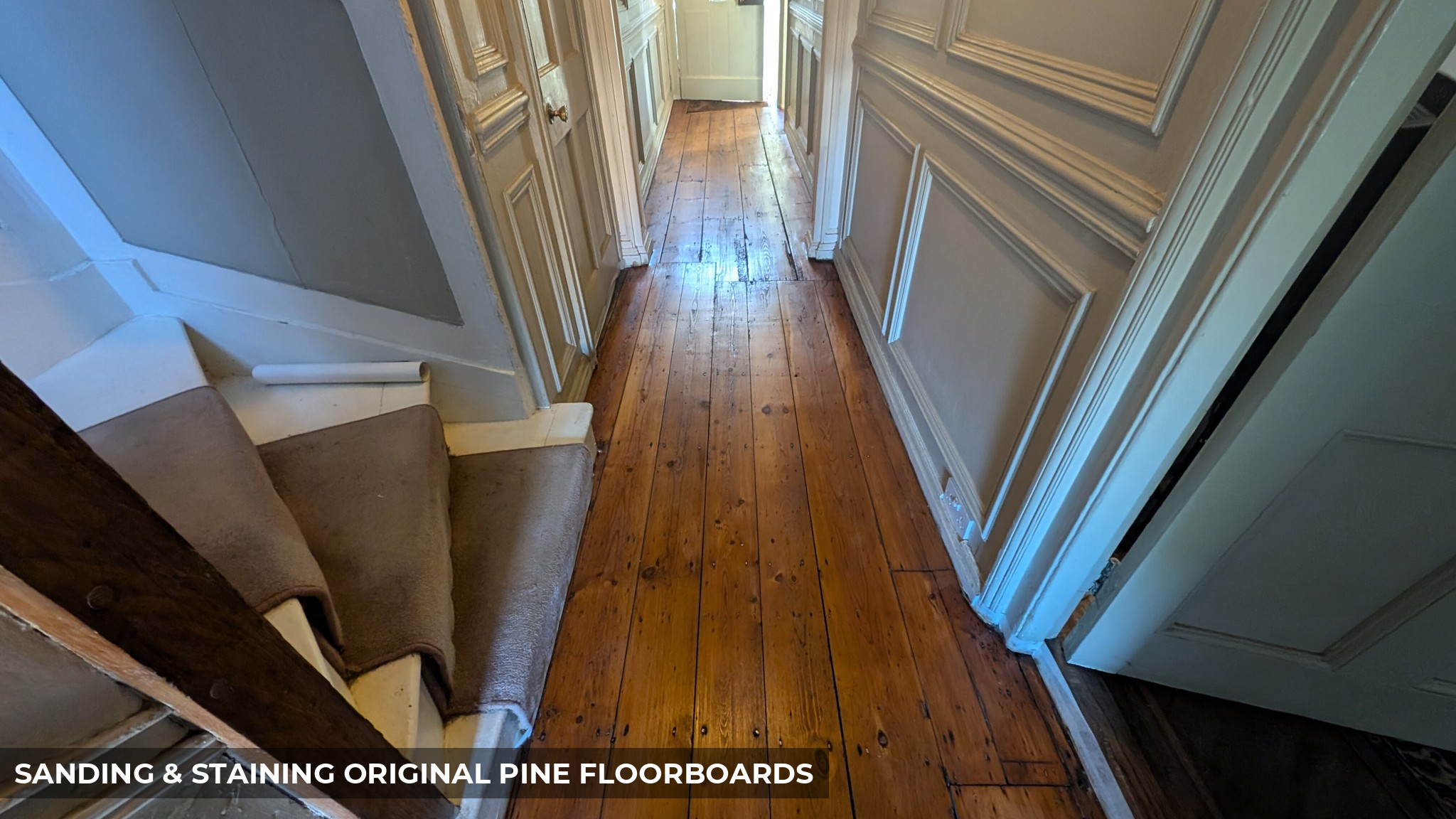
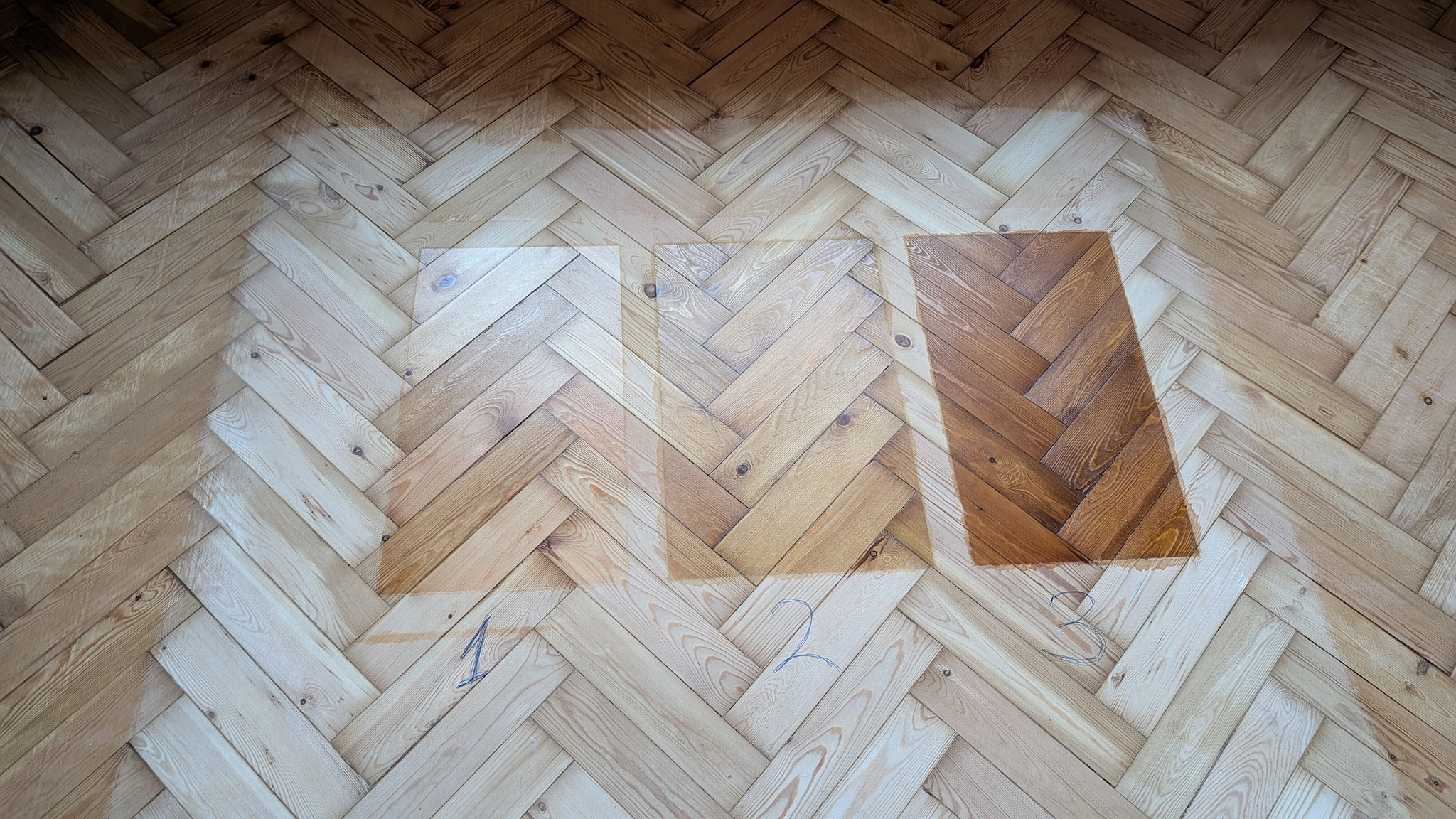
We apply specialized lightfast spirit-based dyes or solvent stains. These dry through rapid carrier evaporation before the soft resin channels become oversaturated. As showcased in our dedicated floorboards restoration services, pine can be stained in rich tones like Jacobean oak, antique pine, or dark walnut while keeping its historic grain patterns crisp and defined.
-
Protective Coating Requirement
Because softwoods compress easily under point loads (such as high heels or furniture legs), soft penetrating oils can wear away quickly in traffic paths. We finish stained pine with a hardwearing, multi-coat waterborne polyurethane lacquer system to create a resilient structural shield over the soft wood.
Engineered Oak
Engineered oak combines a genuine European or American Oak top layer (the lamella) bonded to a cross-laminated birch or eucalyptus plywood core.
-
Wear Layer Preservation
Standard engineered boards feature a 3 mm to 4 mm wear layer, while premium boards provide 5 mm to 6 mm. Because every deep restoration cut removes valuable hardwood, technicians calibrate planetary buffers to level the surface while shaving off less than 0.5 mm of timber.
-
Tannin-Rich Chemistry
Oak contains high levels of natural tannic acid. This chemistry makes oak an exceptional foundation for pigmented stains, whitewashes, and reactive fuming treatments. Its distinct medullary rays create striking tonal contrasts when dark pigments or white liming formulas fill the open grain.
Solid Oak
Solid oak boards handle substantial, deep pigment loads. Our specialized hardwood floor sanding approach accounts for the fact that solid oak expands and contracts across its width in response to seasonal indoor humidity shifts. Technicians must hand-feed pigment deep into bevels, open joints, and tongue-and-groove shoulders so that seasonal shrinkage during dry winter heating seasons will never reveal unstained, pale lines between planks.
Historic Parquet Patterns
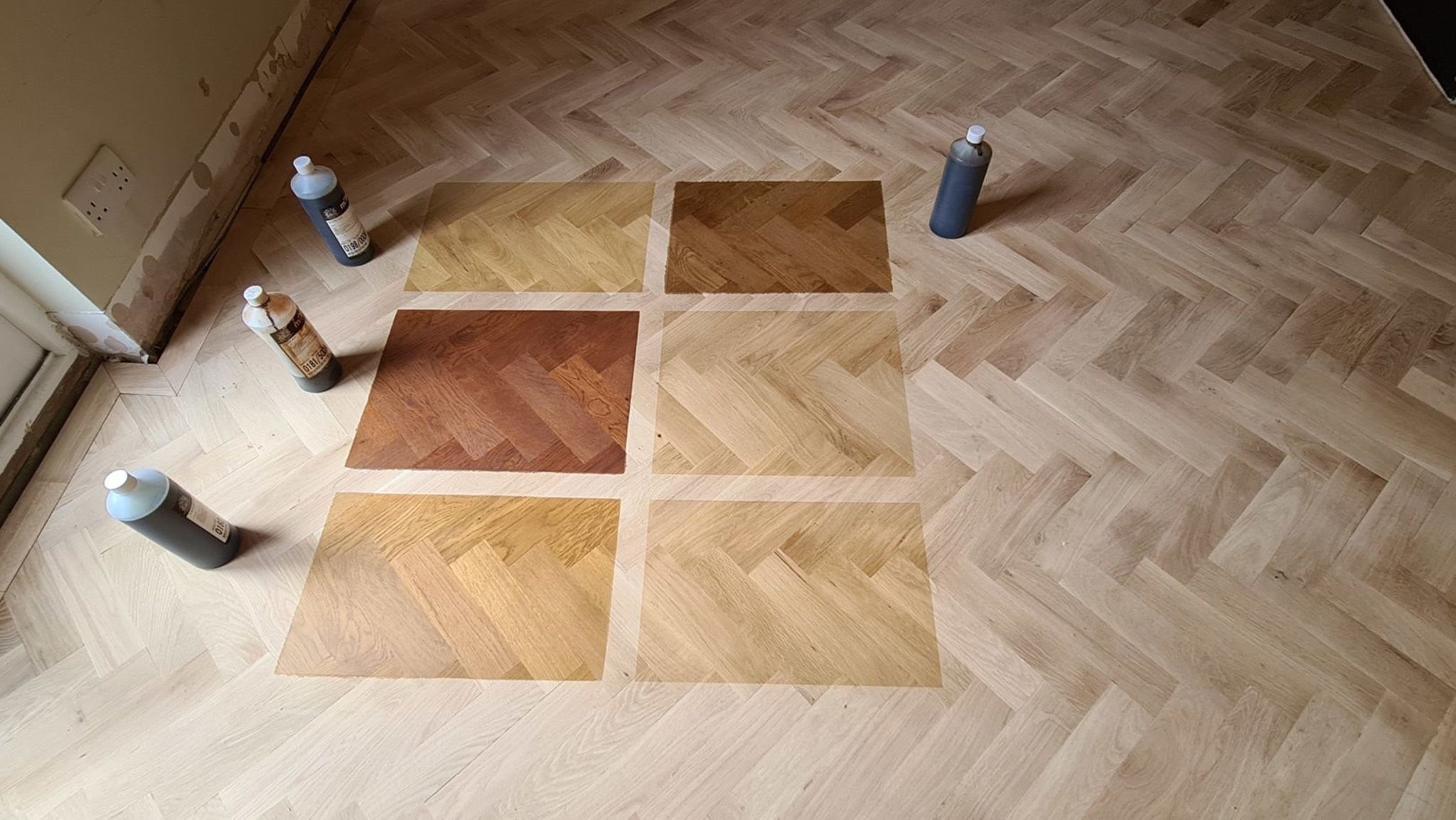
Herringbone, chevron, and mosaic finger panels feature shifting, perpendicular grain alignments. As detailed in our dedicated parquet floor restoration projects, linear staining can cause dark cross-grain lap marks. Technicians employ orbital planetary buffing and mechanical pad application to drive stains into opposing blocks without pooling along block seams.
Closed-Grain Woods (Maple, Beech, Birch)
Maple and Beech are dense, diffuse-porous hardwoods with unpredictable, swirling grain lines and small, tightly packed pores.
-
The Blotching Challenge
When a standard dark pigment is hand-wiped across raw maple, it penetrates unevenly. More porous areas drink in the color, while dense areas resist it entirely, leaving a mottled, blotchy surface.
-
The Solution
Staining closed-grain hardwoods requires specialized techniques: fine-grit progressive sanding, clear wood conditioning bases, or tint-infused sealers applied evenly with a spray gun or mechanical buffer, rather than heavy wipe-on liquid stains.
See the Colour on Your Floor Before You Decide
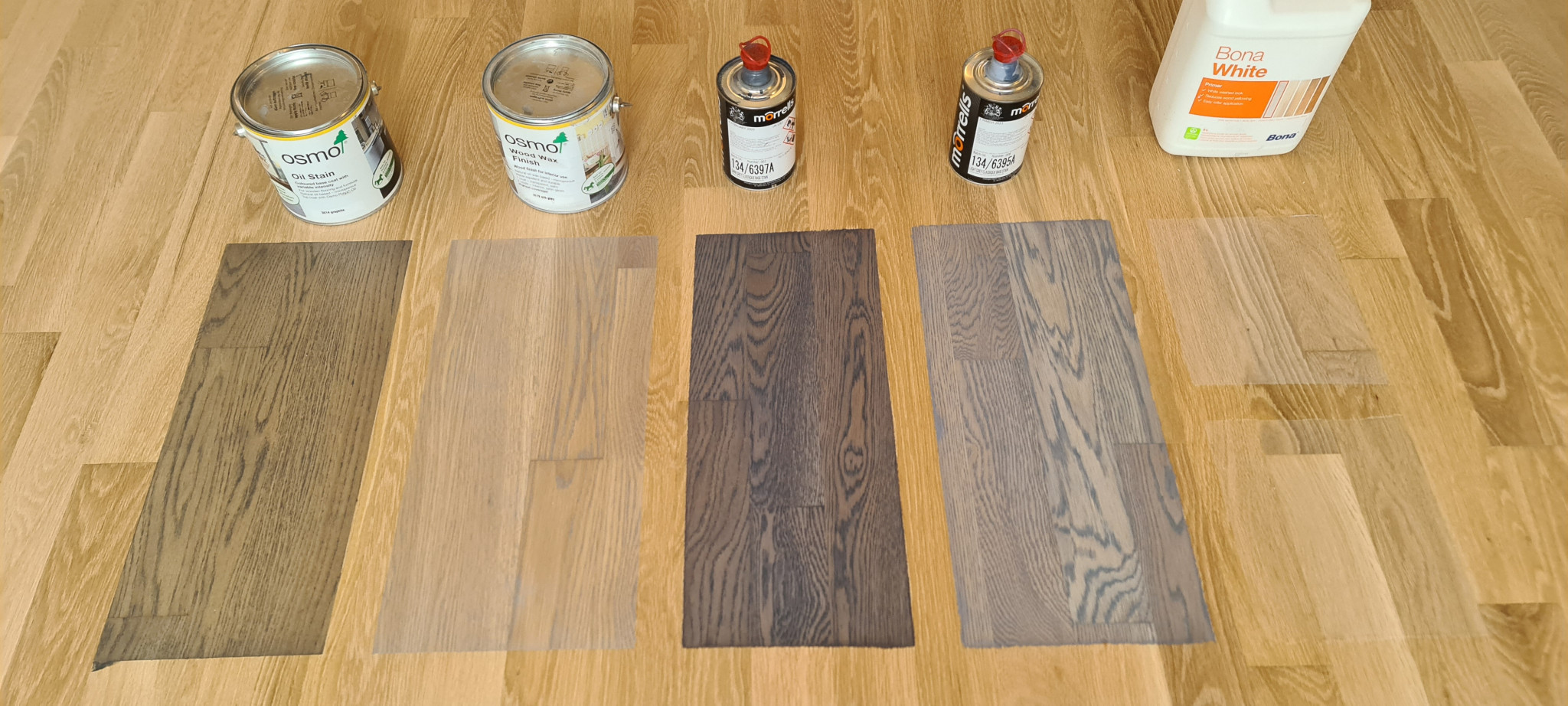
Selecting a timber color from a printed brochure, a mobile screen, or an isolated wood block in a showroom often leads to surprises on site. Wood is a living, variable substrate. The exact same stain will look warm on a 120-year-old resinous pitch pine board, cool on a pale contemporary White Oak board, and muddy on a piece of Beech.
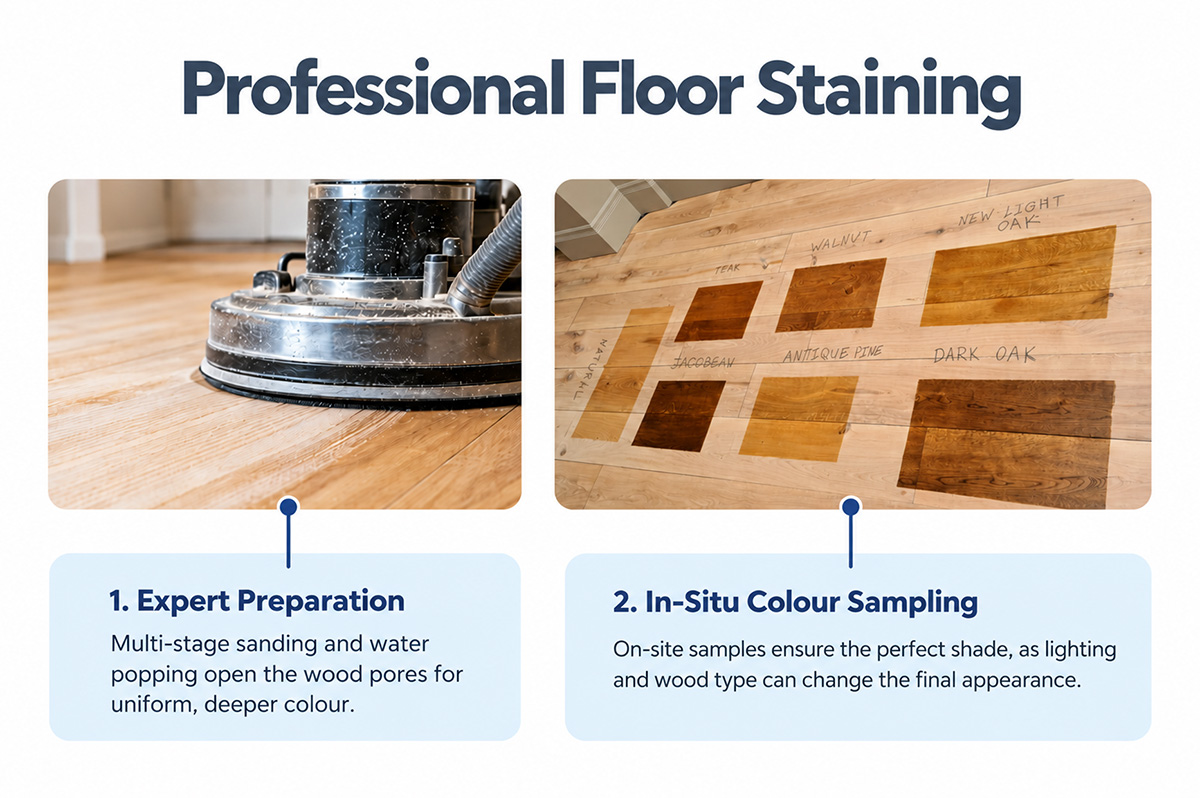
Professional staining requires testing colour sampling—applying actual stain formulas directly to the client's sanded timber floor in the room where it will live.
The Three-Phase Light Evaluation
Color should be reviewed across three distinct lighting environments:
-
Direct Morning and Midday Natural Light
High-kelvin (5000K to 6500K) daylight reveals true undertones, showing whether a brown stain carries subtle green, red, yellow, or pink hues.
-
Dusk and Raking Light
Low-angle exterior light accentuates surface texture and highlights the contrast between the grain and the base wood.
-
Evening Artificial Lighting
Standard warm residential lighting (2700K to 3000K) adds yellow-orange warmth to the room, muting cool gray tones and enhancing amber, golden, and rich brown stains. Conversely, modern commercial lighting (4000K+) can pull hidden blue-gray notes out of dark finishes.
Viewing physical test patches side-by-side in the space guarantees that your chosen tone harmonizes with the interior joinery, architectural moldings, wall paints, and furniture under every daily lighting shift.
Distinct Stain Formulations and Technical Application Methods
Achieving a uniform, high-end finish across hundreds of square meters requires matching the chemical base of the stain to the project's scale, timber species, and design goals.
Lightfast Spirit and Solvent Stains
Formulated with high-grade metal-complex dyes dissolved in fast-evaporating alcohols or solvents, these stains offer exceptional color clarity and UV stability.
-
Application Technique
Because solvent-borne stains flash-dry within minutes, technicians apply them systematically along individual board runs using lambswool applicators or low-pressure sprayers, followed by immediate hand-buffing to eliminate lap marks.
-
Key Benefits
They do not raise the wood grain, which preserves the smooth finish achieved during planetary sanding. They also dry fast, allowing protective primers to be applied the same day.
Pigmented Oil and Hardwax Systems
These formulations blend micronized mineral pigments into natural vegetable oils (linseed, sunflower, soybean) and fluid waxes.
-
Application Technique
The tinted oil is poured onto the floor in small pools and worked into the open wood pores using a heavy, low-speed rotary machine fitted with dense scrubbing pads. Once the timber is saturated, clean cotton or microfiber pads are used to remove every drop of excess surface oil.
-
Key Benefits
This approach drives pigment directly into the open grain while keeping the surface smooth and clear. It prevents color pooling in low spots and leaves an organic, low-sheen, tactile finish.
Reactive Chemical Stains (Fumed and Smoked Effects)
Unlike traditional stains that cover the wood fibers in pigment, reactive stains contain zero pigment particles. Instead, they use active metal salts and alkaline compounds that react chemically with the free tannic acids naturally present within Oak and Chestnut.
Visual Effect: This reaction oxidizes the wood fibers internally, creating warm olive-undertoned ambers, historic fumed grays, or rich smoked charcoals that look like wood aged naturally over centuries. Because the color forms within the timber structure itself, it will never show pigment rub-off or artificial cloudiness.
Contact Us for Professional Flooring Solutions
Get a free flooring advice

Tinted Primers and Micro-Pigment Suspensions
For contemporary Scandinavian, Nordic, or "bare timber" looks, standard penetrating white stains can sometimes sit heavily in the grain, giving the floor an artificial appearance.
Visual Effect: High-tech waterborne acrylic primers contain micro-milled titanium dioxide white pigments that stay suspended throughout the liquid. Applying one coat counteracts the natural ambering of clear seals; applying two to three coats creates a clean, milky, chalk-white wash reminiscent of historic Douglas fir soap-finished floors.
Protective Seal Systems: Performance, Chemistry, and Maintenance
Staining alters the visual tone of wood; it offers zero protection against foot traffic, liquid spills, or surface scratches. Once the stain has flashed off and cured, the floor must be sealed with a compatible topcoat to protect the stained timber from daily wear.
Commercial Two-Component Waterborne Polyurethane Lacquers
Waterborne lacquers (consisting of a polyurethane-acrylic resin base mixed on site with an isocyanate hardener) represent the gold standard for high-traffic homes and commercial facilities serviced under our commercial floor sanding contracts.
-
Chemical Shield
Once dry, the cross-linked polymer creates a clear, durable, and non-porous film over the stained timber.
-
Optical Neutrality
Unlike old-fashioned solvent polyurethanes that dry yellow and continue to darken over time, modern waterborne lacquers are clear and non-yellowing. This keeps pale whitewashes, muted grays, and rich dark stains true to their original color without shifting toward amber.
-
Sheen Variations
Available in Extra-Matt (reflecting less than 5% ambient light to look almost untreated), Natural Matt, Satin, and Semi-Gloss.
-
Ideal Use Cases
Busy residential hallways, kitchens, dining spaces, retail stores, educational facilities, and commercial hospitality venues.
-
Maintenance Profile
Day-to-day care is straightforward: sweep with a dry microfiber pad and damp-mop with a pH-neutral cleaner. Once the lacquer eventually wears through its wear layers after years of service, the floor will require a full mechanical sanding back to bare wood to be resealed.
High-Solid Hardwax Oils and Natural Oil Systems
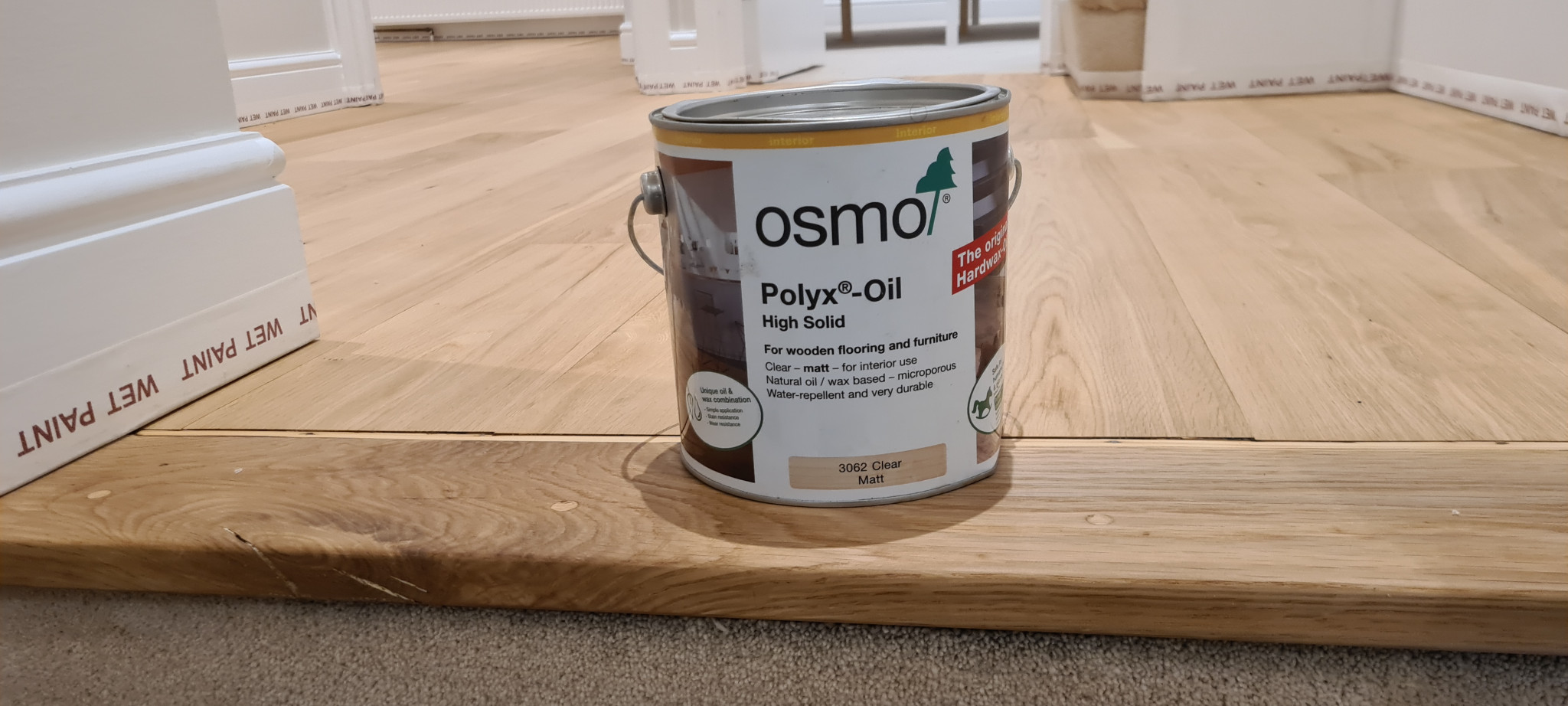
Hardwax oils combine plant-derived oils that soak into the wood pores with refined carnauba and candelilla waxes that cure on the surface.
-
Micro-Porous Protection
Hardwax oils do not form an artificial plastic film across the boards. Instead, they leave the natural texture of the wood grain open and touchable while repelling liquid spills through surface tension.
-
Optical Warmth
Penetrating oils accentuate grain contrast and chatoyancy, creating an authentic, hand-rubbed finish that feels soft underfoot.
-
Ideal Use Cases
Formal reception rooms, master bedrooms, heritage properties, and private boutique interiors where an organic, tactile feel is preferred.
-
Maintenance Profile and Re-Oiling
Unlike lacquered floors that require complete sanding when worn, oiled timber can be refreshed indefinitely. High-traffic walkways that show dullness or micro-scratching can be cleaned and restored locally with a quick re-oiling maintenance pass. As highlighted in our restoration FAQ, routine re-oiling every 12 to 24 months feeds the timber and refreshes its liquid repellency, keeping your stained floors looking their best for decades without needing to resand down to bare wood.
Structural Repairs, Joint Filling, and Edge Detailing
Staining will accentuate any structural shortcuts taken before the finishing stage. If an installer uses standard hardware-store wood filler on a floor scheduled for a dark walnut stain, the plastic filler will reject the stain, leaving bright yellow or pink spots across the room.
Reclaimed Timber Splicing
Damaged planks or boards compromised by past plumbing alterations require professional hardwood floor repairs. Our craftsmen match the growth ring density, grain angle, and species of the surrounding boards so that the repair absorbs stain at the exact same rate as the rest of the floor.
Resin and Dust Joint Filling
For fine parquet joints and minor splits, technicians harvest clean, fine wood flour from the P80 to P100 grit planetary sanding stage. This fine dust is mixed with an elastomeric liquid binder to create a custom, species-matched paste. Because this paste is composed primarily of the actual wood being restored, it accepts stains naturally and blends seamlessly into the surrounding floor.
Reclaimed Pine Slivers for Wide Gaps
For original floorboard gaps wider than 3 millimeters, liquid paste will crack and drop through over time due to seasonal movement. Instead, technicians insert solid, wedge-shaped slivers cut from antique reclaimed pine. These are coated in high-strength woodworking adhesive, driven snugly between the boards along the grain, and hand-planed flush with the floor surface. When stained, these slivers mimic natural wood grain and permanently block cold underfloor drafts.
Get a Free Expert Flooring Advice
The Value of Professional Craftsmanship
Staining a timber floor transforms the interior environment, but it requires exacting execution. A successful restoration demands:
-
Eliminating Lap Marks
Professional rotary buffing and hand-rubbed techniques prevent overlapping lines, edge halos, and stop marks across broad floor expanses.
-
Sealed Dust Extraction
Commercial-grade cyclonic extraction systems keep your interior clean and prevent airborne dust from settling into wet stains or clear topcoats during curing.
-
Chemical Compatibility
Ensuring complete compatibility between mechanical preparation, water-popping levels, stain chemistry, and protective topcoats eliminates the risk of flaking, bubbling, or peeling.
Browse through our completed residential and commercial works in our project gallery to explore real-world transformations. By pairing modern dust-controlled sanding with proven woodworking techniques and quality sealants, professional floor staining protects your architectural timber and delivers a durable, customized finish designed to stand the test of time.